
2 Thermophysiology Basics
How the Body Senses, Regulates, and Responds to Heat
What is Thermophysiology?
Thermophysiology is the study of how the body maintains a stable internal temperature (homeostasis) even when the external environment changes. As homeotherms, humans must stay within a narrow core temperature range (~36.5–37.5°C). Deviations of even 1–2°C can have serious consequences, particularly during exercise, illness, or pregnancy.
The Heat Balance Equation
At the core of thermoregulation is a simple but powerful concept:
The change in temperature is proportional to the heat flow in minus the heat flow out.
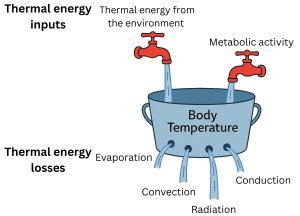
Sources of heat gain:
-
Metabolic activity (muscle work, digestion)
-
External heat (sunlight, hot air, hot surfaces)
Mechanisms of heat loss:
-
Conduction – Heat transfer through direct contact
-
Convection – Heat carried away by moving air or fluid
-
Radiation – Heat radiated into cooler surroundings
-
Evaporation – Heat loss through sweat evaporation (main method in hot environments)
Evaporative heat loss is especially important during physical activity or in hot, dry environments. However, its effectiveness declines sharply in humid conditions.
According to Kenney and Johnson (1992), if heat is not dissipated, core body temperature can rise to the upper safety threshold within 10 minutes of moderate physical activity.
Thermoregulation Is Coordinated by the Brain and Enacted by the Body
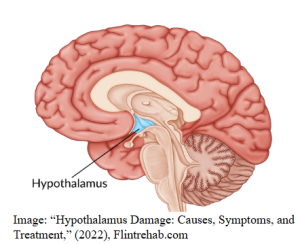
The preoptic area (POA) of the hypothalamus acts as the body’s thermostat. It integrates input from:
-
Peripheral thermoreceptors (in skin)
-
Central thermoreceptors (in brain and spinal cord)
When heat is detected:
-
Sweating is triggered (evaporative cooling)
-
Vasodilation increases blood flow to the skin
-
Behavioral changes (seeking shade, drinking water)
When cold is detected:
-
Shivering increases heat production
-
Vasoconstriction reduces heat loss
-
Non-shivering thermogenesis in brown adipose tissue
Neuronal firing in the POA has been shown to vary with temperature and is influenced by hormonal status, neuropeptides, and synaptic plasticity (Boulant & Dean, 1986; Conti et al., 2006).
Compensable Versus Uncompensable Heat Stress
Compensable heat stress occurs when the body can adequately dissipate heat through its physiological mechanisms. For example, light exercise in cool and dry conditions allows heat to be lost efficiently.
Uncompensable heat stress arises when the rate of heat gain exceeds the body’s capacity to lose heat. This often occurs in hot, humid environments where evaporation is impaired. In these settings, even light physical activity can result in a dangerous rise in core temperature.
This is common in regions facing extreme humidity and poor access to cooling infrastructure.
When Thermoregulation Fails: Heat Illness
The progression of heat-related illness reflects increasing severity of thermal imbalance:
Heat cramps: Involuntary muscle contractions due to fluid and electrolyte depletion
Heat exhaustion: Characterized by fatigue, dizziness, nausea, and heavy sweating
Heat stroke: Defined by a core body temperature exceeding 40°C, accompanied by central nervous system symptoms such as confusion, loss of coordination, or coma. This condition is a medical emergency.
At the Tokyo 2021 Olympics, approximately 1 in 100 athletes experienced heat illness, despite access to elite-level thermoregulation strategies.
Hormonal and Life Stage Influences
Sex hormones affect thermoregulatory set points and physiological responses.
-
Progesterone increases the core body temperature set point. This leads to higher resting temperatures during the luteal phase of the menstrual cycle and throughout pregnancy (Stachenfeld et al., 2000).
-
Estradiol lowers the thermoregulatory set point and promotes heat loss through enhanced vasodilation and sweating (Silva & Boulant, 1986).
-
Menopause is associated with estrogen withdrawal, which can destabilize thermoregulation. This may explain the prevalence of vasomotor symptoms such as hot flashes, which are linked to sudden activation of heat dissipation pathways despite only minor increases in core temperature (Kelly & Rønnekleiv, 2015).
During pregnancy, thermoregulation adapts to support the fetus, which maintains a core temperature 0.3 to 0.5°C higher than the mother. These changes reduce the maternal threshold for initiating heat loss responses (Samuels et al., 2022).
Quick Recap
- The body maintains core temperature through brain-coordinated responses.
- Thermoregulation depends on both heat dissipation and hormonal signals.
- Climate change and hormonal states (e.g., pregnancy) make this system more vulnerable.
References
Boulant, J. A., & Dean, J. B. (1986). Temperature receptors in the central nervous system. Annual Review of Physiology, 48, 639–654. https://doi.org/10.1146/annurev.ph.48.030186.003231
Carleton, T., Jina, A., Delgado, M., Greenstone, M., Houser, T., Hsiang, S., … & Zhang, A. T. (2022). Valuing the global mortality consequences of climate change accounting for adaptation costs and benefits. The Quarterly Journal of Economics, 137(4), 2037–2105. https://doi.org/10.1093/qje/qjac020
Conti, B., Sanchez-Alavez, M., Winsky-Sommerer, R., Morale, M. C., Lucero, J., Brownell, S., … & Bartfai, T. (2006). Transgenic mice with a reduced core body temperature have an increased life span. Science, 314(5800), 825–828. https://doi.org/10.1126/science.1132191
Kelly, M. J., & Rønnekleiv, O. K. (2008). Modulation of hypothalamic neuronal activity through a novel G-protein-coupled estrogen receptor. Steroids, 73(9–10), 985–991. DOI 10.1016/j.steroids.2007.11.008.
Kenney, W. L., & Johnson, J. M. (1992). Control of skin blood flow during exercise. Medicine and Science in Sports and Exercise, 24(3), 303–312. https://doi.org/10.1249/00005768-199203000-00010
Sawka, M. N., Leon, L. R., Montain, S. J., & Sonna, L. A. (2011). Integrated physiological mechanisms of exercise performance, adaptation, and maladaptation to heat stress. Comprehensive Physiology, 1(4), 1883–1928. https://doi.org/10.1002/cphy.c100082
Silva, N. L., & Boulant, J. A. (1986). Effects of steroid hormones on thermosensitive neurons in hypothalamic tissue slices. The American Journal of Physiology, 250(3), R625–R632.
Media Attributions
- Hypothalamus Pituitary Hormones (50.799 x 100.575 cm) (1)
- Screenshot 2025-06-08 102810